
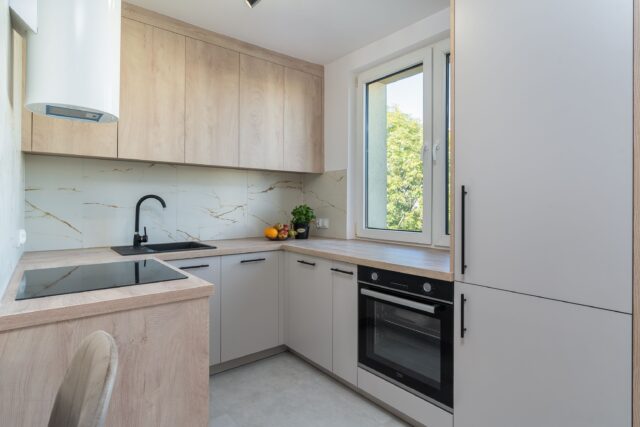
Every kitchen has at least one corner that seems to swallow space rather than offer it. Good kitchen corner storage ideas turn that dead zone into some of the most useful storage in the room, but only if the right system is matched to the right corner. At Nicholas Hythe we plan corner storage as part of the full kitchen design, not as an afterthought squeezed in once the layout is fixed, which is why we rarely see a blind corner written off as wasted space in one of our kitchens.
The problem with kitchen corners, explained simply
Wherever two runs of cabinets meet at a right angle, you get a corner cupboard with a deep, dark space behind the door hinge that is awkward to reach and easy to lose things in. This is usually called a blind corner, because roughly a third of the cabinet’s floor area sits directly behind the door swing of the cupboard next to it and cannot be reached in a straight line.
Standard hinged doors make this worse rather than better. Open the door and you are still reaching around a right angle into a space you cannot fully see, which is why so many corner cupboards end up storing whatever was pushed in last, rather than what you actually use. The fix is not a bigger cupboard, it is a mechanism built for the shape of the space, and there are several worth knowing about before you choose one.
Carousel and magic corner units
A carousel unit uses rotating shelves, usually a full circle or a three-quarter turn, fixed to a central post so the whole shelf swings out into the room as you open the door. It is the simplest and most familiar corner solution, and it works well for lighter items such as pans, tins and everyday crockery where quick access matters more than maximum capacity.
A magic corner works differently. Two wire baskets are linked so that opening the door pulls the front basket out and around, which in turn draws the hidden rear basket out behind it, bringing the entire blind corner into full view and reach in one movement. It is more mechanically complex than a carousel and costs more, but it recovers close to the full floor area of the cupboard, including the part a carousel cannot reach.
For a well used family kitchen, a magic corner is usually worth the extra cost, since it is the only mechanism that solves the blind corner problem rather than working around it. A carousel remains a sensible, lower cost choice for a corner that only needs to hold a handful of everyday items.
Corner drawers
Corner drawer units pull straight out rather than rotating, using angled or curved drawer fronts engineered to clear the adjacent cabinet as they open. Because everything sits in a drawer rather than behind a door, the entire contents are visible and reachable from above in one motion, which suits kitchens where the household values speed and simplicity over squeezing in the last possible litre of storage.
They work best in an L-shaped kitchen where the corner sits between two runs of base units at a similar height, and where you want the corner to hold everyday items such as pans or utensils rather than deep, infrequently used stock. They generally hold slightly less than a magic corner of the same footprint, since some of the awkward depth is designed out rather than made accessible.
Pull-out and swing-out systems (Le Mans style)
Le Mans style units use a pair of fan-shaped shelves mounted on an arm that swings the shelves fully out of the cabinet and into the room when the door opens, clearing the corner completely rather than reaching into it. The name comes from the sweeping arc of the motion, similar to a pit lane turn.
This is one of the more expensive corner mechanisms, but it gives genuinely unobstructed access to every item on the shelf, with nothing left in shadow at the back of the cabinet. It suits a corner base unit with a single door rather than a bi-fold or two-door corner, so it needs to be planned into the cabinet layout from the start rather than retrofitted.
Corner larders and tall corner storage
Where floor space allows, a tall corner unit turns the same awkward geometry into full-height storage, using either an internal carousel or a series of pull-out wire baskets fixed to the door itself, similar in principle to a magic corner but running from worktop height to the top of the cabinet run.
A corner larder suits a kitchen where you want a genuine pantry function without giving up a full run of wall units elsewhere, storing everything from tins and packets to small appliances behind one set of doors. It is a strong option for a family kitchen where floor space in the corner is available but wall space is already committed to something else.
How we plan corner storage into a bespoke design
Corner storage only works well when it is chosen at the layout stage, not added afterwards, which is why it is part of our kitchen design service from the first conversation about your kitchen, alongside decisions about worktops, appliances and cabinet runs.
Our Schuller and Next125 German kitchen ranges include factory engineered corner systems, including magic corners and Le Mans units, built to the same precision tolerances as the rest of the cabinetry, so the mechanism runs smoothly for years rather than sagging or sticking the way a poorly specified corner unit can. We will talk through which mechanism suits each corner in your kitchen, rather than fitting the same solution to every one.
If your interest is storage more broadly rather than corners specifically, our kitchen storage hacks for small homes guide covers the wider picture, from vertical space to multi-functional furniture.
Frequently Asked Questions
What is the best kitchen corner storage solution?
Are magic corners worth it?
How do I make use of a blind corner cupboard?
Book a free design visit
Book a free design visit to see the corner storage systems working in person at our St Ives or Ely showroom, and talk through which mechanism suits the corners in your kitchen.