Not All Shaker Kitchens Are the Same
Ask ten people to describe a Shaker kitchen and you’ll get ten versions of the same answer: clean lines, a framed door, painted finish. They’re not wrong. But Shaker is a broader family than that suggests, and the differences between a traditional Shaker, a slim Shaker, a beaded Shaker, and an in-frame Shaker are real enough to change how a kitchen feels in a room. This is what distinguishes each one.
What Makes a Kitchen “Shaker”?
A Shaker door has a flat recessed panel set within a frame of rails and stiles. That’s it. The name comes from the Shaker movement: American, 18th century, known for furniture built without ornament for its own sake. A Shaker kitchen isn’t stark, but it isn’t decorative either. The design works through proportion and material, not surface detail.
Where Shaker kitchens diverge is in how wide the frame is, what detail sits on or around it, and how the door connects to the cabinet. Those three variables produce four meaningfully different kitchens.
Traditional Shaker
A traditional Shaker kitchen uses a wider frame and a deeper routed profile around the central panel. The proportions are deliberate and grounded. With the right colour, handles and worktop, it can also look contemporary. It’s the version most people picture first.
It often suits farmhouse kitchens, cottage kitchens, and rooms where the architecture has weight: period properties around St Ives and Ely, older rural homes in Huntingdon or Ramsey. The wider rail gives painted finishes more surface to land on, which is part of why traditional Shaker and painted cabinetry have always belonged together.
Slim Shaker
A slim Shaker kitchen uses a narrower frame around the same recessed panel. The rails and stiles are more slender, the profile shallower. The door is still recognisably Shaker in structure, but it sits closer to contemporary cabinetry in feel.
This is the version that bridges traditional and modern. It often works well in newer homes, open-plan kitchen diners, and spaces where the architecture is clean rather than characterful. It also helps in smaller kitchens. A wide traditional frame in a galley layout can feel heavy. A slim version keeps the run of units from closing in.
Slim Shaker pairs well with handleless hardware and understated stone worktops. In a new-build in Cambridge or a modern extension in Newmarket, it can carry the cleaner look the space calls for while still reading as designed rather than generic.
Beaded Shaker
A beaded Shaker door adds a small moulding to the inner edge of the frame. One extra element, but it shifts the character noticeably, from plain-framed to something closer to Victorian joinery. It gives the door a more furniture-like, crafted feel.
It often works well in period properties of that era: terraced houses and semis in Cambridge, Ely, or Huntingdon where the architecture has decorative brickwork or period cornicing. The bead detail resonates with that language without being imitative.
It’s a more specific choice than traditional or slim Shaker, and it’s worth seeing in person before committing. The detail reads differently under different lighting conditions and with different finishes.
In-Frame Shaker
An in-frame kitchen is a different construction entirely. In a standard kitchen, doors and drawer fronts sit on the front face of the carcass. In an in-frame kitchen, the carcass is fronted by a rigid structural frame, and the doors sit within that frame rather than on top of it. The result looks more like furniture than fitted units.
In-frame is a construction choice rather than a door style, and the door in the frame can itself be a traditional or slim Shaker. Not every Shaker kitchen is in-frame.
What in-frame delivers is solidity and precision. When a door is fitted closely within its frame, the kitchen looks built rather than bought. The tolerances are tighter, which is why in-frame needs more careful planning and installation. Done well, the frame carries the visual weight and the cabinet is built for long-term use.
Nicholas Hythe designs and installs in-frame kitchens across Cambridgeshire, from villages around St Ives and Ely to larger homes in Cambridge. For more on the construction, the in-frame kitchens page covers what distinguishes this build in detail.
A Quick Comparison
Traditional, slim and beaded Shaker are door styles. In-frame is a construction method, and can be combined with a traditional or slim Shaker door.
Style | Frame | Often chosen for | Character |
Traditional Shaker | Wider, deeper profile | Period homes, farmhouse, cottage | Warm, classic |
Slim Shaker | Narrower, shallower | Contemporary spaces, smaller rooms | Cleaner, lighter |
Beaded Shaker | Bead detail on inner edge | Victorian, Edwardian, heritage homes | Craft-influenced |
In-Frame (construction) | Door sits within a structural front frame | High-spec, long-term builds | Furniture quality |
How to Choose
The architecture of the home is a useful starting point. A period farmhouse or Victorian terrace often suits a traditional or beaded Shaker, or an in-frame construction if the specification supports it. A contemporary extension or open-plan ground floor often suits a slim Shaker, where the narrower frame keeps the run of units from feeling heavy. There’s no fixed rule, and there’s often more flexibility than these guidelines suggest.
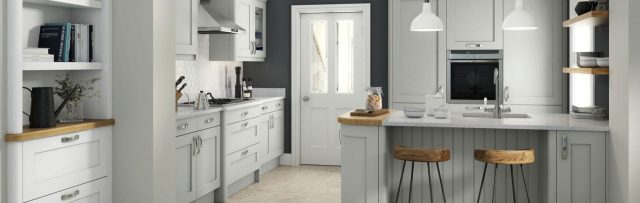
A recent kitchen in Ely pairs Shaker doors in a soft Sage finish with Natural Lancaster Oak interiors and solid oak worktops. In Bluntisham, near St Ives, light grey Shaker cabinetry is paired with contrasting dark green units.
Scale matters too. Traditional and in-frame doors read well in rooms with height and space. In a smaller kitchen, slim Shaker gives enough detail to read as intentional without occupying visual space the room can’t spare.
If you’re unsure, the most reliable way to decide is to see the styles alongside each other. The difference between a traditional and a beaded Shaker is subtle in a photograph. In a showroom, under changing light, it’s immediately apparent.
Nicholas Hythe’s showrooms in St Ives and Ely display a selection of Shaker kitchens. To talk through which style suits your home, book a free design visit at home or at either showroom. No obligation, and a designer will give you an honest view of what works in your space.
A Shaker Kitchen in St Ives: The Bradbury Project
The Bradbury project in St Ives shows how a Shaker kitchen works in a deep colour, as part of a wider redesign of the ground floor.
Working with the homeowners, Nicholas Hythe removed a non-load-bearing internal wall, blocked two redundant doorways and opened up the existing connection between the dining room and lounge. The result is a more open kitchen and dining space with better circulation and room for both cooking and entertaining.
The cabinetry uses Aldana solid ash Shaker doors in a painted Indigo finish, with the ash bringing warmth and texture to the deep blue. Antique brass-effect handles complement the doors, and Blanco Ice quartz worktops give a clean, bright contrast.
A generous peninsula with a waterfall worktop detail and a built-in Caple wine cooler adds preparation space and informal seating. Storage includes wide pan drawers, a pull-out corner system, slim pull-out units, integrated recycling and a fitted cutlery organiser, alongside NEFF appliances including a Slide&Hide oven and induction hob.
The adjoining utility room uses the same Indigo Shaker cabinetry and quartz worktops, so the two rooms read as one scheme. Nicholas Hythe coordinated the building alterations, replacement ceilings, new lighting and radiators, electrical and plumbing work, plastering, decorating and installation.